Why Service Pages Should Not All Say the Same Thing
Many local service pages are built by swapping the city name and leaving everything else alone. Use this checklist to decide which pages deserve unique proof, clearer answers, and a stronger contact path before publishing more near-duplicates.
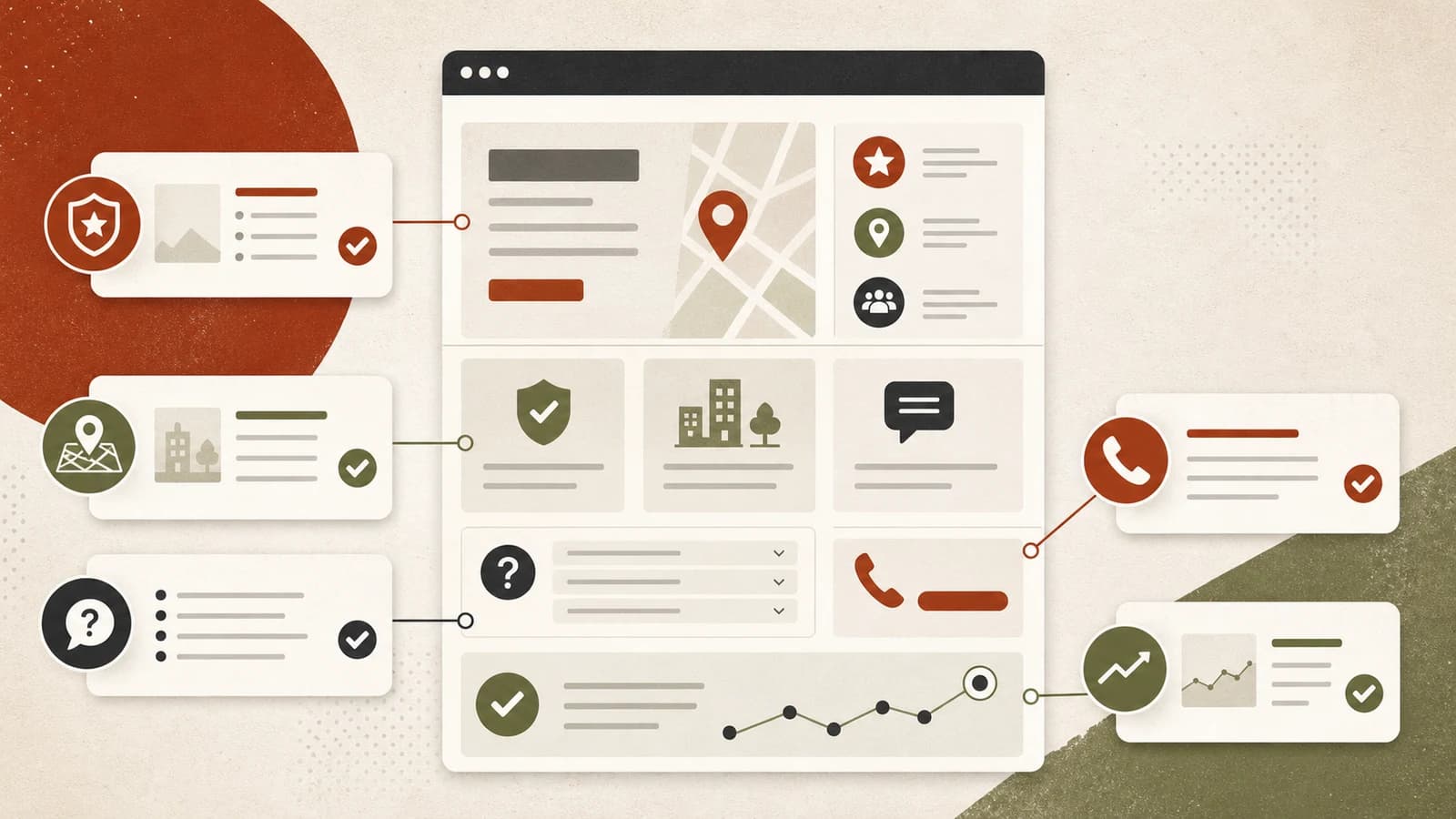
Service pages are easy to duplicate. Change the heading, swap the service name, maybe replace one city, and the page looks finished.
That is also why so many local service pages fail.
A buyer is not trying to admire a page template. They are trying to decide whether this service fits their problem, whether the business works in their area, whether there is enough proof to trust the next step, and whether calling or submitting the form will be worth it.
The practical decision task is this: decide which service pages need unique proof, FAQ, local context, and calls before more copies are published.
Start With The Buyer Decision
Before rewriting a service page, name the decision it should help someone make.
Use this quick map:
| Page type | Buyer decision | Page evidence that helps |
| --- | --- | --- |
| Core service page | Is this the right service for my problem? | Symptoms, fit, process, examples, service boundaries |
| Local service page | Do they actually serve my area and understand my situation? | Area served, local constraints, map or neighborhood context, location-specific proof |
| Specialty service page | Do they handle this specific case? | Use cases, before-and-after notes, tool or material details, constraints |
| Emergency or urgent page | Can I act quickly and know what happens next? | Phone path, response expectations, service limits, intake steps |
| High-value service page | Can I trust them enough to start a conversation? | Proof, FAQs, process, pricing context, next action |
If two pages support different decisions, they can share the same site design while still needing different body copy.
If two pages support the exact same decision and only the keyword changes, pause before publishing another one.
Find The Copy-Swap Pattern
The fastest service page cleanup is a plain comparison.
Open three or four pages in the same family and look for these signals:
- The first paragraph uses the same sentence structure on every page.
- The proof section is generic or absent.
- The FAQ answers are identical across services.
- The city or service name is the only meaningful change.
- The CTA is the same even when the buyer need is different.
- The page never explains who should not use the service.
- The page has no internal links to related services, pricing, contact, or resources.
- Tracking cannot tell which page helped create the lead.
That pattern is common on local service sites because it feels efficient. It also creates pages that are hard for visitors, search systems, and AI answers to distinguish.
Google's helpful content guidance is a useful pressure test here: after reading the page, would a visitor feel they learned enough to move forward? If not, the page probably needs more than keyword variation.
Give Each Important Page Its Own Proof
Unique service page copy does not mean writing a dramatic essay for every URL. It means giving important pages their own useful evidence.
Use this checklist before rewriting:
| Page element | Weak version | Stronger version |
| --- | --- | --- |
| Opening | "We provide professional services in your area." | "This page is for owners comparing repair, replacement, and maintenance options before booking a visit." |
| Service fit | Broad claims | Specific problems, conditions, exclusions, and who the service is for |
| Local context | City name swap | Service area notes, travel or appointment expectations, local constraints, nearby location context |
| Proof | "Trusted by customers" | Visible examples, review themes, portfolio references, certifications, process notes, or QA steps |
| FAQ | Same questions everywhere | Questions that match the service and buyer hesitation |
| CTA | Generic contact button | Call, book, request audit, or ask for estimate based on the page purpose |
| Tracking | One form with no source detail | Hidden source fields, page path, campaign, and call tracking where appropriate |
For local service page SEO, the useful work is often specific but not flashy:
- Rewrite the first screen so the service, area, and next action are clear.
- Add one section that explains when this service is the right fit.
- Add one section that explains what happens after a call or form submission.
- Add FAQs that answer real objections.
- Link to related services, the local business website page, the cleanup sprint, and contact.
- Preserve the landing page path in the lead record so reporting can show which page helped.
That is the difference between "we need more pages" and "we need better pages that can earn the call."
Avoid Doorway-Style Local Pages
Local pages can be useful. They become fragile when they exist mostly to capture search visits and funnel people through the same thin experience.
Google's spam policies describe doorway pages as pages or sites created to rank for specific similar queries while sending users to substantially similar destinations. The warning sign for a local business is not the existence of service-area pages. It is the combination of scale, sameness, and thin value.
Ask these questions before adding more service or location variants:
- Does this page explain a real service or location difference?
- Would a customer in that area learn anything different here?
- Is the page useful if someone reaches it directly, without a search result?
- Does it show visible facts that support the service, area, proof, and next action?
- Does it avoid hidden text, keyword stuffing, fake examples, and unsupported claims?
- Does the page link naturally to the next best action instead of trapping visitors in a thin funnel?
If the answer is mostly no, do not create more variants yet. Improve the service-page system first.
Match Structured Data To Visible Page Facts
Structured data should not be used to make weak service pages look stronger than they are.
Google's structured data guidelines expect markup to represent visible page content. For local service pages, that means the page body should support the service name, business details, area served, FAQ answers, contact path, image, and any local business information you mark up.
Use this simple fact map:
| Visible fact on the page | Possible structured data support |
| --- | --- |
| Business name and website | Organization or LocalBusiness fields when appropriate |
| Service name and description | Service-related page content and schema when the implementation supports it |
| Area served | LocalBusiness or service-area details only when visible and accurate |
| FAQ questions and answers | FAQPage only when those FAQs are shown to visitors |
| Breadcrumb trail | BreadcrumbList when navigation reflects the page path |
| Contact option | Phone, URL, or action path when supported by visible page content |
Do not add FAQ markup for hidden questions. Do not mark up reviews, offers, locations, or services that the page does not show. Do not expect schema to solve a page that still needs clearer copy and better proof.
For AI-search readiness, the same rule applies: make the page clear enough to cite, then let markup describe the page honestly.
Clean Up The Service Page System Before Publishing More
A useful cleanup sprint does not need to rewrite the entire site at once. It needs a smart order of operations.
Start with pages that have one or more of these traits:
1. They are tied to a profitable service.
2. They receive local search impressions.
3. They are linked from the main navigation or paid campaigns.
4. They sit before the call, booking, or form path.
5. They have obvious copy-swap wording.
6. They have missing or duplicated FAQs.
7. They send leads into a CRM without page source context.
Then review each page with this operator checklist:
| Check | Pass question |
| --- | --- |
| Purpose | Can we say what decision this page helps the buyer make? |
| First screen | Is the service, area, proof, and action path clear on mobile? |
| Distinct value | Would this page still be useful if the keyword were removed? |
| Proof | Does the page show specific trust signals, examples, process, or constraints? |
| FAQ | Do the questions answer actual buyer hesitation for this service? |
| Internal links | Does the page connect to related services, resources, audit, and contact paths? |
| Tracking | Can calls and forms preserve the page path or source context? |
| Markup | Does structured data match visible content? |
Ashfield's action path is straightforward:
- Use `/solutions/website-local-seo-cleanup-sprint` when service pages need copy cleanup, local context, internal links, and contact-path repair.
- Use `/solutions/local-business-websites` when the site needs a broader local business page system, not just a single rewrite.
- Use `/solutions/conversion-tracking-lead-attribution` when calls and forms do not preserve the page that helped create the lead.
- Use `/audit` when you are not sure which page family is leaking trust or leads.
- Use `/resources` when you want checklists before committing to a sprint.
- Use `/contact` when one service page family needs a scoped review.
The goal is not to make every page longer. It is to make every important page easier to understand, easier to trust, easier to track, and easier to act on.
Sources Used For This Service Page Checklist
- Google Search Central: Creating helpful, reliable, people-first content: https://developers.google.com/search/docs/fundamentals/creating-helpful-content
- Google Search Central: Spam policies for Google web search: https://developers.google.com/search/docs/essentials/spam-policies
- Google Search Central: General structured data guidelines: https://developers.google.com/search/docs/appearance/structured-data/sd-policies
- Google Search Central: Local business structured data: https://developers.google.com/search/docs/appearance/structured-data/local-business
FAQ
Is it bad if service pages use the same layout?
Using the same layout is normal. The problem is when the pages say the same thing, answer no distinct buyer question, show no page-specific proof, and only swap a service name or city. Keep the template if it helps usability, but make the decision-making content unique where it matters.
What should make a local service page unique?
A useful local service page should explain the specific service, who it is for, common situations, area or location context when relevant, proof or examples, FAQ answers, contact expectations, and a clear next step. It should feel like a page built for that buyer decision, not a cloned doorway.
Do duplicate service pages cause a penalty?
Duplicate wording alone is not the best way to frame the risk. The larger issue is intent and usefulness. Pages created mainly to capture search traffic, especially many similar geographic or service variants, can become spammy if they do not provide distinct value for users.
Should every service page have FAQ schema?
No. Add FAQ schema only when the questions and answers are visible on the page and genuinely help the buyer. Google structured data guidelines expect markup to represent visible page content. If the FAQ is not useful enough to show, it should not be added only for markup.
Which service pages should Ashfield clean up first?
Start with pages that already get impressions, receive paid or local traffic, support important services, or sit in the path to calls and forms. Clean up the page purpose, proof, FAQs, internal links, tracking, and call path before creating more variants.
Keep reading
What Fail-Closed QA Means Before a Local Post Goes Live
AI and content calendars make it cheap to ship local posts. Fail-closed QA is the opposite habit: named checks that block publish when the copy would misrepresent a shop, pad a suburb, skip the call path, or invent a fact.
What Actually Moves Calls for Multi-Location Home Services (Maps, Pages, Conversion)
If call volume is flat, more blog posts are usually the wrong first move. Inspect the Maps listing a buyer actually sees, the location or service page they land on, and the tap-to-call or form path that has to finish the job.
How Multi-Location Home Service Brands Keep City Pages Distinct
A city-page farm can look like coverage while giving buyers the same thin answer in ten URLs. Use this method to approve only the markets that differ, publish what must be distinct, and keep those pages current on a weekly cadence.