How Agencies Can Clear Technical SEO Backlogs Without Hiring
Agencies do not need to hire full-time for every technical SEO backlog. They need clean delegation rules, useful handoff notes, acceptance criteria, and QA evidence.
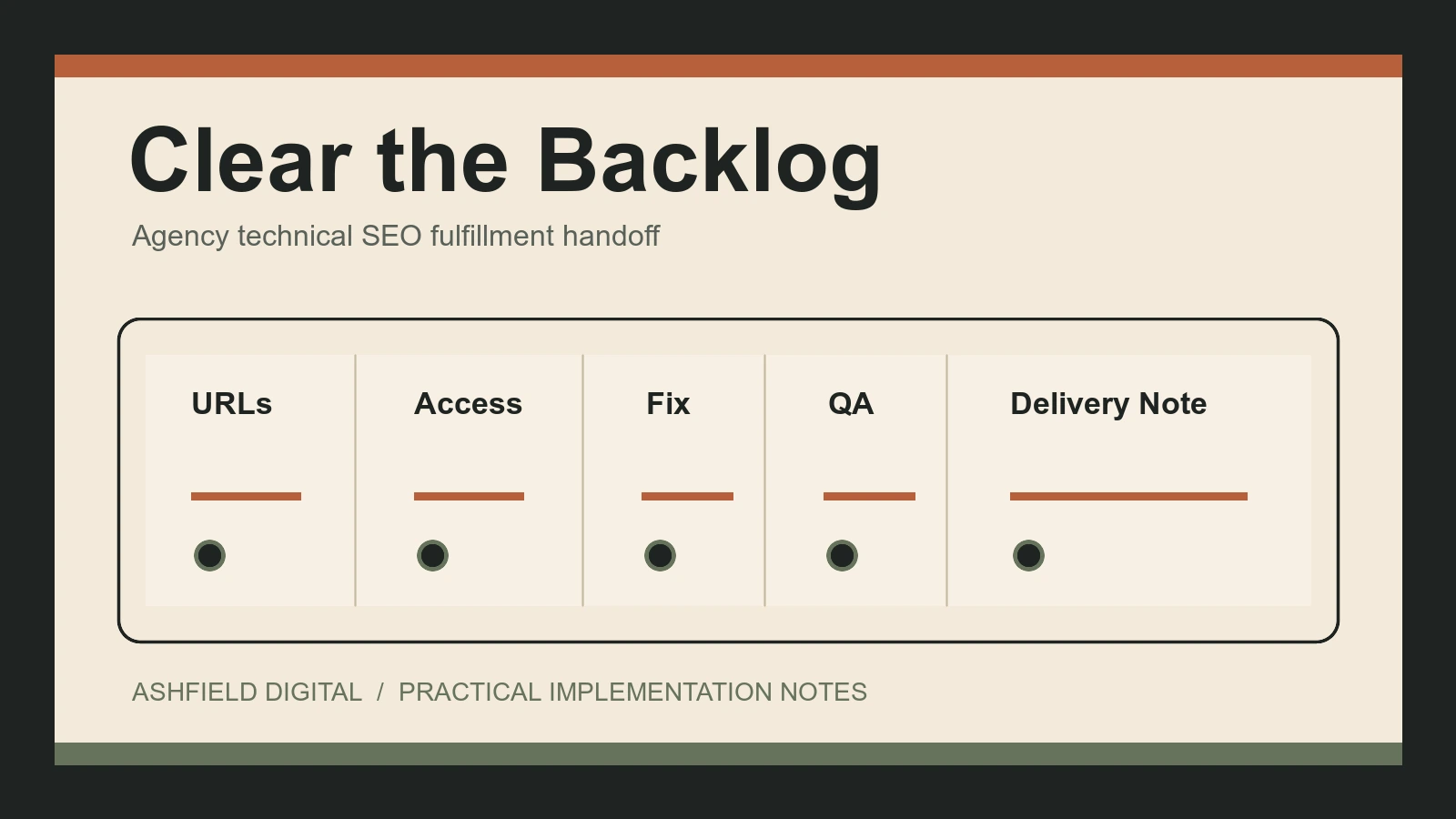
The technical SEO backlog usually grows in a familiar way. The audit is approved, the account team understands the problem, the client expects visible progress, and the actual implementation is waiting behind developer availability, CMS access, tracking QA, or a pile of scattered notes.
Hiring full-time is not always the right answer. For many agencies, the better decision is to separate the work that must stay with the agency from the work that can move to a white-label implementation partner this week. That is the decision this article is meant to support.
The useful question is not "Can we outsource technical SEO?" The useful question is: which approved fixes can be delegated safely, with enough context that the work ships cleanly and the client relationship stays protected?
Start With The Delegation Decision
Technical SEO fulfillment works when the agency has already made the strategic call. The partner is not being asked to invent the campaign, sell the client, or decide what matters to the account. The partner is being asked to turn approved recommendations into site changes, QA records, and delivery notes.
Before anything leaves the agency team, sort the backlog into three lanes:
- Delegate now: the fix is approved, the URL is known, the expected change is clear, and validation is possible.
- Clarify first: the fix may be right, but the account team still needs client context, brand approval, legal review, or prioritization.
- Keep internal: the task changes campaign strategy, client messaging, pricing, scope, or a sensitive claim.
That sorting step protects everybody. It keeps the account team in charge of the promise and lets the implementation partner focus on shipped work.
For Ashfield's agency fulfillment work, good delegated tasks often include website fixes, landing page updates, internal linking, schema cleanup, tracking QA, reporting support, and technical SEO implementation. The agency still owns the client narrative, approvals, and final recommendation.
What Agencies Can Delegate Safely
The safest agency technical SEO fulfillment tasks have four traits: they are scoped to specific URLs, tied to an approved recommendation, technically doable with available access, and verifiable after launch.
Good candidates include:
- Metadata cleanup where the target page, search intent, and client-approved positioning are already clear.
- Internal link additions from known pages to priority service, location, product, or resource pages.
- Schema cleanup when the markup needs to reflect visible page facts, not invent new claims.
- Redirect, canonical, sitemap, crawl, or indexation fixes with a defined expected state.
- CMS page edits that improve headings, FAQs, proof, action paths, or page structure.
- Form, call, analytics, and source-context QA where the test path can be repeated.
- Landing page adjustments that were already approved by the account or creative team.
Notice what is not in that list: "make the client rank better" or "improve the page somehow." Those are outcomes and opinions, not implementation tickets. A useful ticket says what needs to change, where, why, and how the agency will know it shipped.
What Should Stay With The Account Team
The agency team should keep anything that changes the client relationship, the business priority, or the public promise. A fulfillment partner can offer a technical opinion, but the agency should decide whether that opinion belongs in the client plan.
Keep these with the account team:
- Client prioritization and budget tradeoffs.
- Brand, legal, medical, compliance, or claim-sensitive copy.
- Final recommendations about what the campaign should do next.
- Sensitive performance interpretation.
- Client-facing explanation of delays, scope changes, or strategic pivots.
- Final approval on page messaging, offer language, and service positioning.
This boundary matters most when the backlog includes healthcare, regulated services, multi-location businesses, or local service pages with specific licensing, service area, or claim requirements. The implementer can clean the page structure. The agency should decide what the page is allowed to say.
Google's people-first content guidance is a useful guardrail here. The page should help the reader or buyer, not merely satisfy a search tactic. In agency fulfillment terms, that means delegated fixes should improve visible usefulness, clarity, crawlability, or measurement. They should not create thin rewrites, hidden text, fake proof, or markup that says more than the page itself says.
Use A Handoff That Removes Guesswork
Most fulfillment problems are not caused by bad intentions. They are caused by vague handoffs. The implementer receives a crawler export, an old audit note, and a message that says "can you fix these?" Then the agency loses time answering questions that could have been included upfront.
A useful handoff can be short. It just needs the right fields:
- Client and project: account name, workstream, and urgency.
- Goal: what business or campaign problem this fix supports.
- Affected URLs: exact pages, staging links, or CMS entries.
- Source: where the recommendation came from, such as an audit, Search Console check, client request, or account-team review.
- Access: CMS, repo, analytics, Search Console, tag manager, or form tool access needed.
- Requested fix: the specific change to ship.
- Acceptance criteria: what must be true when the task is done.
- QA path: how to verify the fix on desktop, mobile, crawler, Search Console, or tracking tools.
- Delivery note: the format the agency wants for client-safe reporting.
Here is a simple example:
- Goal: make the client service page easier to crawl and easier for visitors to act on.
- URL: `/services/commercial-hvac-maintenance`.
- Requested fix: update H1, add two internal links from relevant blog posts, add visible FAQ section, mark up only the visible FAQ answers, and confirm the form still preserves landing page context.
- Acceptance criteria: page renders correctly, links work, FAQ text is visible, structured data matches the visible FAQ, and the form test records source/page context.
- Delivery note: list what changed, what was tested, and what remains blocked.
That is enough to ship useful work without pulling the account lead into every implementation detail.
Verify The Fix Before It Becomes Client-Facing
Technical SEO fulfillment should end with evidence, not vibes. The agency needs to know what changed, how it was checked, and whether any blocker remains.
A clean QA trail can include:
- Before and after URL or screenshot.
- The exact field, component, CMS entry, code file, or setting changed.
- Rendered page check on desktop and mobile.
- Link, form, call, or tracking test where relevant.
- Crawl or indexation check when the issue affects discovery.
- Structured data validation when markup changed.
- A plain-language note the account team can adapt for the client.
Google's technical requirements are the baseline: the page needs to be accessible, crawlable, and technically eligible for Search. Google's structured data guidance adds an important quality rule: markup should represent the page's visible content and follow the relevant policy. That is why a fulfillment partner should not quietly add schema for claims, FAQs, reviews, services, or offers the visitor cannot actually see.
For some tasks, Search Console's URL Inspection tool can help confirm what Google knows about a specific page or test whether a live URL may be indexable. That does not guarantee ranking or traffic. It simply turns one part of the validation process into evidence instead of guesswork.
When Overflow Support Beats Hiring
Hiring makes sense when the agency has predictable technical demand, enough management bandwidth, and a clear role that will stay full. Overflow support makes sense when the work is real but uneven.
Use a partner when:
- The backlog is approved, but client work spikes by week or month.
- The agency needs technical SEO, web, tracking, reporting, and CMS help in the same queue.
- The internal team is strong on strategy but light on implementation capacity.
- Clients need visible shipped work before a full-time hire would pay off.
- The agency wants white-label support without adding another public vendor to the client relationship.
The goal is not to hide a weak operation. The goal is to protect a strong one from stalling. Reserved capacity, scoped projects, or hourly support can help the agency keep delivery moving while staying honest about what is strategy, what is implementation, and what still needs client approval.
Ashfield's Agency Action Path
Ashfield's agency fulfillment path is built for teams that already have clients and need senior implementation capacity for website fixes, technical SEO, landing pages, tracking, reporting, local SEO, and automation. It can be white-label or named-partner support depending on the relationship.
If the backlog is mostly technical SEO, start with `/solutions/technical-seo-services` and define the shipped-fix queue. If the blocker is forms, calls, UTMs, analytics, or CRM source context, use `/solutions/conversion-tracking-lead-attribution` to scope the tracking work. If the agency needs an ongoing execution lane, use `/solutions/agency-fulfillment-partner` and bring the current backlog to the intro call.
The first conversation should be practical:
- What client work is approved but stuck?
- Which URLs and systems are involved?
- What access exists today?
- What needs to stay with the agency?
- What would count as shipped by Friday?
That conversation is enough to decide whether the right fit is hourly overflow, reserved monthly capacity, a project-based implementation block, or no fit.
Sources Used For This Fulfillment Standard
- Google Search Central: Creating helpful, reliable, people-first content: https://developers.google.com/search/docs/fundamentals/creating-helpful-content
- Google Search Central: Google Search technical requirements: https://developers.google.com/search/docs/essentials/technical
- Google Search Central: General structured data guidelines: https://developers.google.com/search/docs/appearance/structured-data/sd-policies
- Google Search Console Help: URL Inspection tool: https://support.google.com/webmasters/answer/9012289?hl=en
FAQ
What technical SEO tasks can agencies delegate?
Agencies can usually delegate scoped implementation work: metadata cleanup, internal links, schema fixes, redirect notes, CMS updates, page-speed hygiene, conversion tracking QA, landing page changes, and post-launch validation. The task should have approved intent, affected URLs, access, and acceptance criteria before it leaves the account team.
What should stay with the agency account team?
Client strategy, prioritization, budget conversations, sensitive tradeoffs, legal or medical claims, brand positioning, final client communication, and anything that changes the promise of the campaign should stay with the agency. A fulfillment partner can ship and document work, but the agency should own the relationship and business decision.
What handoff notes prevent client risk?
The safest handoff names the client goal, affected URLs, source of the recommendation, exact fix requested, known constraints, required access, acceptance criteria, QA steps, reporting format, and who approves exceptions. Missing notes create rework because the implementer has to guess what the client was sold.
How should shipped fixes be verified?
Use a short validation trail: before and after URL, screenshot or code note, rendered page check, Search Console or crawler check when relevant, tracking test for forms or calls, and a plain delivery note. Structured data should match visible page facts and technical fixes should be tied to the original issue.
When does overflow support beat hiring?
Overflow support is usually better when demand is approved but uneven, the backlog crosses web development and SEO specialties, or the agency needs shipped work this month without adding payroll. Hiring makes more sense when the same technical role is needed every week at predictable volume.
Keep reading
What Fail-Closed QA Means Before a Local Post Goes Live
AI and content calendars make it cheap to ship local posts. Fail-closed QA is the opposite habit: named checks that block publish when the copy would misrepresent a shop, pad a suburb, skip the call path, or invent a fact.
What Actually Moves Calls for Multi-Location Home Services (Maps, Pages, Conversion)
If call volume is flat, more blog posts are usually the wrong first move. Inspect the Maps listing a buyer actually sees, the location or service page they land on, and the tap-to-call or form path that has to finish the job.
How Multi-Location Home Service Brands Keep City Pages Distinct
A city-page farm can look like coverage while giving buyers the same thin answer in ten URLs. Use this method to approve only the markets that differ, publish what must be distinct, and keep those pages current on a weekly cadence.