How to Use AI for Website Updates Without Publishing Sloppy Copy
AI can speed up website updates, but it should not remove judgment from the publishing process. Use this review-gated workflow to turn drafts into useful, sourced, page-fit content.
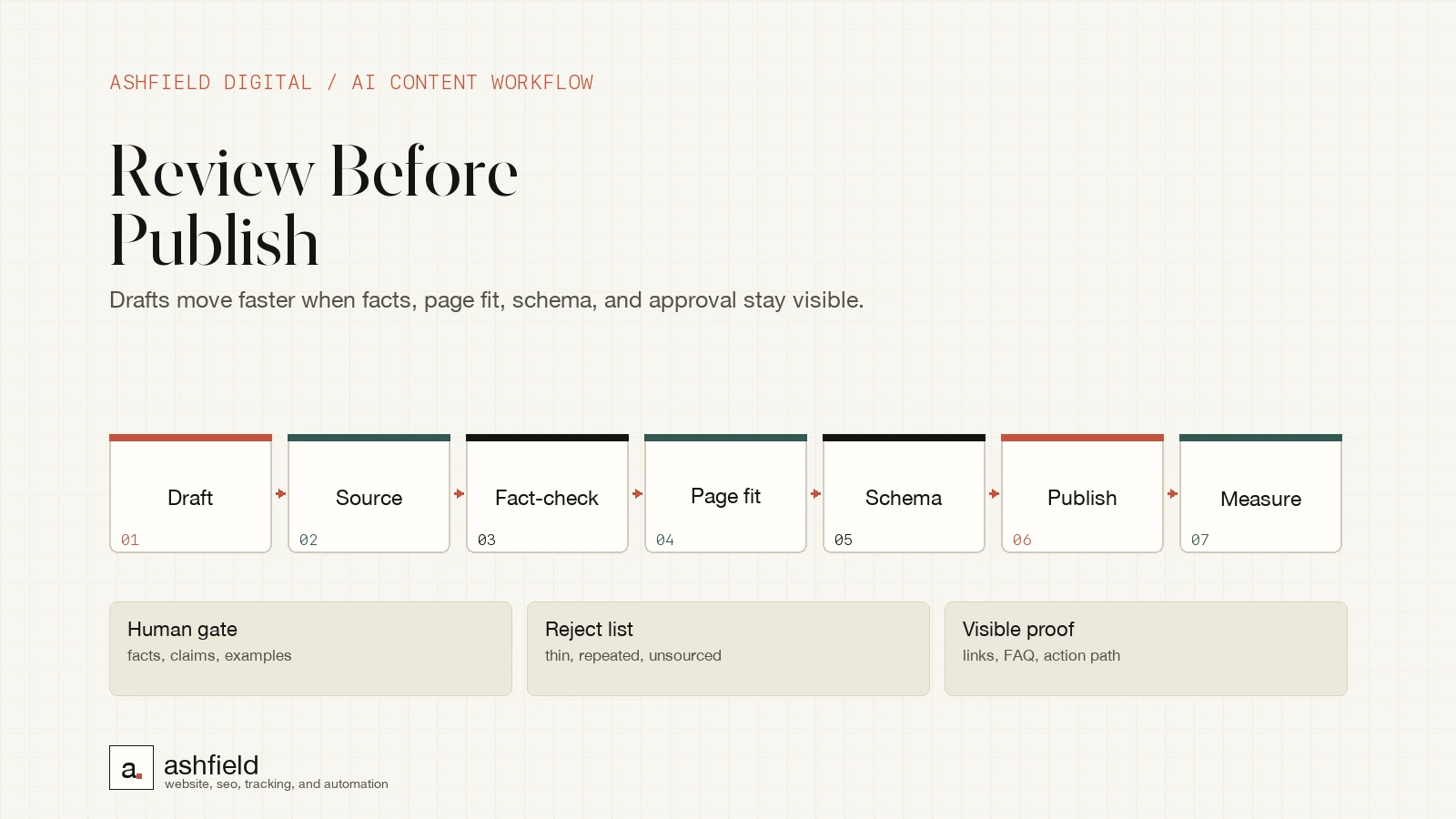
AI can help with website updates. It can also make a site worse faster.
The difference is the workflow around the draft. If the process is "ask for copy, paste it into the CMS, publish, and hope," the business is likely to ship vague claims, stale facts, repeated service pages, weak FAQs, and content that sounds polished but says very little.
A better review workflow keeps the useful parts of AI while protecting the site from sloppy copy. AI can structure rough notes, propose missing sections, turn approved examples into clearer language, and prepare review packets. A person still needs to verify the facts, decide whether the update belongs on the page, and reject drafts that do not help the visitor.
The decision task is simple: use AI to speed up website updates without removing source material, review, or publishing judgment.
Give AI Better Inputs Than A Page Title
Most weak AI website copy starts with weak inputs.
"Write a service page about commercial HVAC repair" is not enough. That prompt invites generic copy because the model has no specific offer, buyer, proof, service area, constraints, or business context to work from.
Before drafting, collect a source packet:
| Input | Why it matters |
| --- | --- |
| Page goal | Defines what the visitor should understand or do after reading. |
| Service facts | Keeps the copy tied to what the business actually sells. |
| Buyer question | Prevents the draft from becoming a broad encyclopedia summary. |
| Proof | Gives the page real credibility without inventing examples. |
| Constraints | Flags claims, topics, prices, locations, or language that need caution. |
| Current page URL | Helps preserve useful sections and internal link context. |
| Internal links | Connects the update to the right service, audit, pricing, or contact path. |
| Sources | Gives the reviewer a way to check claims before publishing. |
| CTA | Makes the next action obvious instead of tacking on a generic closing line. |
For Ashfield work, that source packet might include the page being updated, the offer it supports, the buyer question, approved proof, internal links, and any review rules that must be respected before publishing.
AI should draft from that packet. It should not invent the packet.
Use AI Where It Helps Safely
AI is useful when the work is repeatable, structured, and reviewable.
Good uses include:
- Turning call notes into a rough service-page outline.
- Converting a checklist into cleaner website copy.
- Finding missing buyer questions on a page.
- Drafting FAQs from approved sales questions.
- Suggesting internal links based on a known list.
- Creating a before-publish review checklist.
- Rewriting approved facts for clarity.
- Summarizing source material for a reviewer.
- Preparing a comparison table from details the business already provided.
Riskier uses include:
- Creating many near-identical city or service pages.
- Writing claims without a source.
- Describing results the business has not documented.
- Adding reviews, ratings, credentials, or case details from memory.
- Rewriting regulated or sensitive language without approval.
- Publishing FAQs that do not appear visibly on the page.
- Generating pages mainly to chase search rankings.
Google's guidance on generative AI content is not "AI is banned." The useful standard is whether the content helps people and follows Search Essentials and spam policies. AI can assist with research and structure. It becomes a problem when it is used to generate low-value pages at scale or remove the human work that makes content accurate and useful.
That is why the workflow matters more than the tool.
Build A Review Gate Before The CMS
The safest place to catch sloppy copy is before it reaches the CMS.
A review-gated publishing workflow should separate these stages:
1. Source packet.
2. Draft.
3. Fact check.
4. Page-fit review.
5. Link and CTA review.
6. Schema and metadata review.
7. Human approval.
8. Publish.
9. Post-publish QA.
10. Measurement note.
Use a simple review table:
| Review item | Pass question |
| --- | --- |
| Business facts | Are services, locations, pricing notes, availability, names, and claims accurate? |
| Buyer usefulness | Does the update help a visitor make the decision this page exists to support? |
| Proof | Are examples, testimonials, screenshots, credentials, and results real and approved? |
| Sources | Are external references reliable and used only where they support visible claims? |
| Internal links | Do links point to the next useful Ashfield path, such as resources, audit, pricing, or contact? |
| Repetition | Does this page say something distinct, or is it a copy-swapped version of another page? |
| Schema | Does markup match visible content on the page? |
| Risk | Are regulated, legal, financial, medical, employment, or guarantee-style claims reviewed? |
| Publishing log | Can the team see what changed, who approved it, and why it shipped? |
This does not need to be heavy. For a small business, it can be a checklist in a review packet. For a larger team, it can become an approval queue with blockers, notes, version history, and reminders.
The important rule is that AI drafts do not become published pages just because they are fluent.
Reject Drafts That Look Useful But Are Not
Sloppy AI copy often sounds calm and professional. That makes it easy to miss.
Reject a draft before publishing when it:
- Opens with a broad definition the visitor did not need.
- Uses confident claims without source material.
- Repeats the same section pattern across several pages.
- Adds city, service, industry, or audience terms without specific proof.
- Uses "comprehensive," "seamless," "cutting-edge," or similar filler instead of operational detail.
- Invents benefits, timelines, team size, client results, or capabilities.
- Hides uncertainty instead of explaining what the business can and cannot verify.
- Adds FAQ answers that are not supported elsewhere on the page.
- Treats internal links as keyword anchors instead of useful next steps.
- Exists mainly because a keyword appeared in a spreadsheet.
Google's spam policies describe scaled content abuse as creating many pages primarily to manipulate rankings rather than help users. That can happen with AI, humans, templates, or a mix of all three. The risk is not the label "AI content." The risk is low-value, unoriginal, search-first publishing.
A better rejection rule is plain: if the business would not want a real buyer, partner, or customer to make a decision from the page, do not publish it.
Make Facts, Sources, And Examples Visible
Useful AI-assisted content still needs visible facts.
For a website update, facts can include:
- What the service includes.
- Who it is for.
- Who it is not for.
- What the first step looks like.
- What the business needs from the customer.
- What proof exists.
- What constraints apply.
- What the price or scope depends on.
- What happens after someone contacts the business.
Sources should support claims that need outside grounding. For this article, the relevant sources are Google's guidance on generative AI content, people-first content, spam policies, AI features, and structured data. For another page, the right sources might be product documentation, government guidance, manufacturer specs, first-party process notes, or an approved scope document.
Do not use sources as decoration. Use them to make the page more accurate.
A practical source check looks like this:
| Draft claim | Review action |
| --- | --- |
| "AI content can rank if it is helpful." | Link to Google's AI content guidance and keep the claim modest. |
| "This workflow prevents all SEO risk." | Reject. No workflow can promise that. |
| "FAQ schema can be added to any page." | Rewrite. Schema should match visible page content and follow guidelines. |
| "The business has helped 200 clients." | Verify with approved proof or remove. |
| "Same-day turnaround is available." | Confirm current capacity before publishing. |
The goal is not to slow every update down. The goal is to keep the fast path honest.
Keep Schema And AI-Search Readiness Boring
There is no separate magic layer for AI search.
Google's AI feature guidance points back to the same foundations: make pages accessible to Search, follow policies, and create helpful, reliable, people-first content. That is good news. It means the durable work is still the work a buyer can see.
For AI-assisted website updates, check:
- The page can be crawled and rendered.
- The main content is visible, not hidden in images or scripts.
- The page answers related questions in plain language.
- The FAQ section appears visibly before FAQ schema is added.
- Article, organization, breadcrumb, and service data match the page.
- Sources and examples support the claims.
- Internal links connect the page to related services and next actions.
- Metadata summarizes the page accurately.
Structured data can help search systems understand a page, but it is not a place to stuff extra claims. Google's structured-data guidelines require markup to reflect the page content. If the page does not visibly answer a question, do not mark it up as an FAQ. If the page does not show a review, do not add review markup. If the service details changed, update the visible copy before touching the schema.
Good AI-search readiness looks ordinary from the outside: useful sections, clear answers, accurate facts, visible proof, honest limitations, and a next step that matches the visitor's decision.
Use A Small Publishing Log
AI-assisted publishing improves when the team keeps a record of what happened.
A lightweight log should capture:
- Page URL.
- Update type.
- Source packet location.
- Draft date.
- Reviewer.
- Blockers found.
- Final approval.
- Publish date.
- Schema or metadata changed.
- Internal links added.
- Post-publish QA result.
- Measurement note for later review.
For example:
| Field | Example |
| --- | --- |
| Page | `/solutions/ai-workflow-automation` |
| Update | Added review-gated publishing section and FAQ |
| Source packet | Sales-call notes, Google guidance, Ashfield workflow notes |
| Blocker | Draft invented a guarantee about faster rankings |
| Fix | Removed guarantee and reframed as a review process |
| Approved by | Owner |
| QA | Links, metadata, FAQ, and schema checked |
| Next review | Revisit after two qualified inquiries or 30 days |
That log is useful for more than accountability. It shows which prompts fail, which source packets are incomplete, which pages keep needing the same fix, and which approval rules should become part of the workflow.
Ashfield's AI Website Update Path
Ashfield treats AI as part of a production workflow, not a shortcut around judgment.
The practical path is:
- Use `/solutions/ai-workflow-automation` when the business needs a repeatable draft, review, approval, and publishing process.
- Use `/resources` when the team needs templates, checklists, or plain-language planning help before changing pages.
- Use `/audit` when the current site needs a broader review of content, tracking, SEO, and conversion paths before new updates are prioritized.
- Use `/solutions/technical-seo-services` when the issue involves schema, crawlability, internal links, redirects, or implementation QA.
- Use `/pricing` when the decision is whether this should be a one-week sprint, project, or recurring operating workflow.
- Use `/contact` when the next step is a scoped conversation about one workflow worth making reliable.
The useful question is not "Can AI write this?" It is "What source material, review rule, and publishing check would make this safe to ship?"
When that workflow exists, AI can help a business update pages faster without turning the site into a stack of vague, search-first drafts.
Sources Used For This AI Website Content Workflow
- Google Search Central: Guidance on using generative AI content: https://developers.google.com/search/docs/fundamentals/using-gen-ai-content
- Google Search Central: Spam policies for Google web search: https://developers.google.com/search/docs/essentials/spam-policies
- Google Search Central: Creating helpful, reliable, people-first content: https://developers.google.com/search/docs/fundamentals/creating-helpful-content
- Google Search Central: AI features and your website: https://developers.google.com/search/docs/appearance/ai-features
- Google Search Central: General structured data guidelines: https://developers.google.com/search/docs/appearance/structured-data/sd-policies
FAQ
Can AI be used for website content updates?
Yes, AI can help organize notes, draft first passes, suggest missing sections, create checklists, and turn approved source material into clearer page copy. It should not publish directly without review. A useful workflow keeps human approval, source checks, page-fit review, and publishing logs in the process.
What should a human review before AI-written copy goes live?
Review the business facts, service details, prices, availability, claims, examples, testimonials, sources, internal links, CTA, schema fields, and whether the content answers the page's real buyer question. The reviewer should also check tone, repetition, accuracy, and whether the draft adds value beyond generic summary text.
How do you avoid scaled content abuse when using AI?
Avoid creating many similar pages mainly to manipulate search rankings. Each page should have a real user purpose, original source material, accurate visible facts, useful examples, and a clear reason to exist. If a draft is thin, duplicated, or not helpful to a visitor, do not publish it.
Does AI content need special schema for AI search?
No special AI schema is required. Structured data should describe the visible content on the page and follow normal Google structured-data guidelines. FAQ or Article markup should match what users can read. Do not add markup for claims, questions, services, or reviews that are not visible and accurate on the page.
What is a review-gated publishing workflow?
A review-gated workflow separates drafting from publishing. AI can prepare a draft, but the system then checks sources, facts, links, page fit, schema, and risk before a human approves the final version. The publish step happens only after the review is logged and blockers are cleared.
Keep reading
What Fail-Closed QA Means Before a Local Post Goes Live
AI and content calendars make it cheap to ship local posts. Fail-closed QA is the opposite habit: named checks that block publish when the copy would misrepresent a shop, pad a suburb, skip the call path, or invent a fact.
What Actually Moves Calls for Multi-Location Home Services (Maps, Pages, Conversion)
If call volume is flat, more blog posts are usually the wrong first move. Inspect the Maps listing a buyer actually sees, the location or service page they land on, and the tap-to-call or form path that has to finish the job.
How Multi-Location Home Service Brands Keep City Pages Distinct
A city-page farm can look like coverage while giving buyers the same thin answer in ten URLs. Use this method to approve only the markets that differ, publish what must be distinct, and keep those pages current on a weekly cadence.