Why an SEO Audit Fails When Nobody Owns the Fixes
An audit only creates value when someone owns each fix, understands its dependencies, and can prove the change shipped correctly. Use this practical handoff system to assign work, order it by business impact and implementation risk, and keep findings from disappearing between teams.
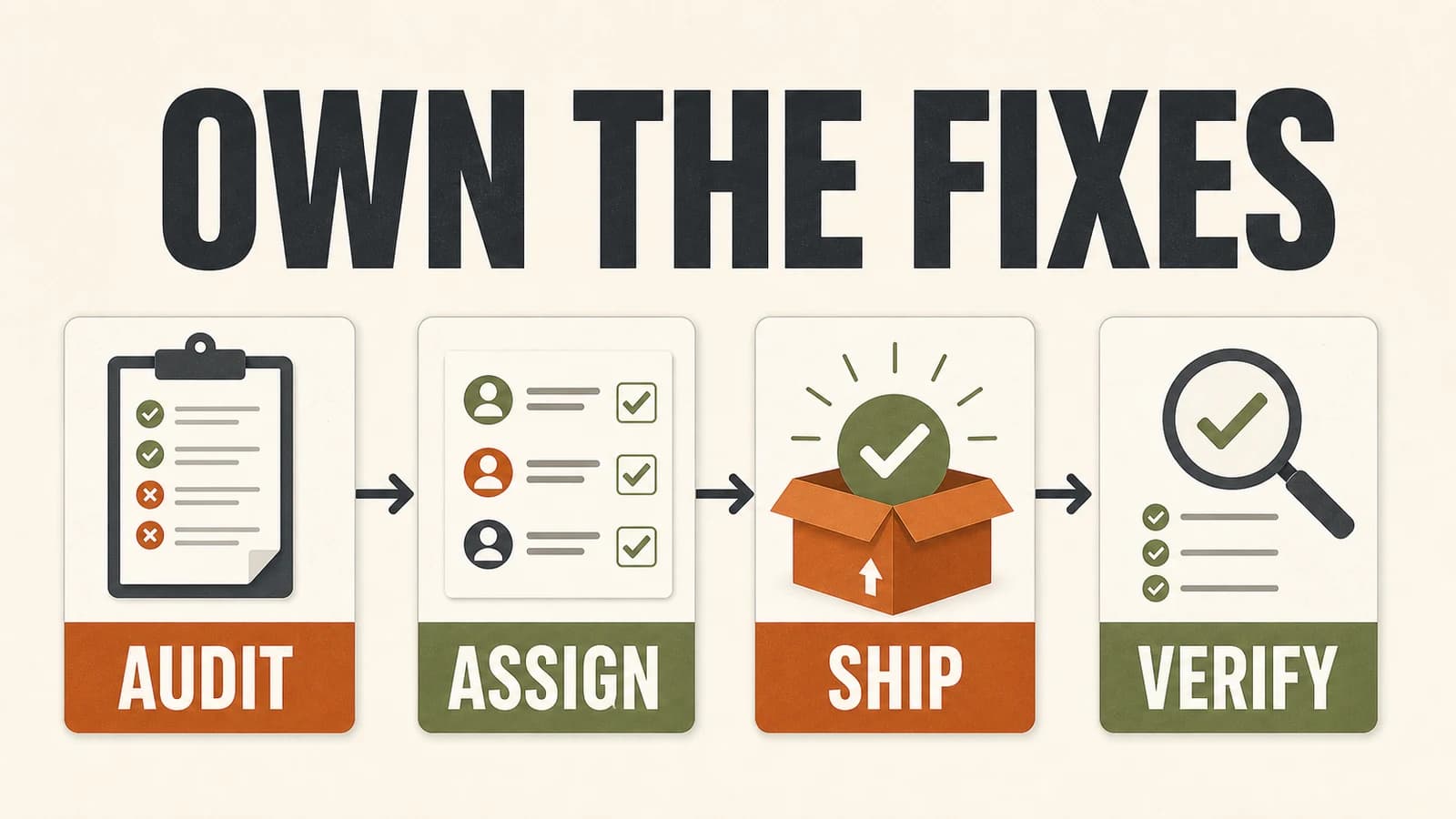
An SEO audit can be accurate, detailed, and completely ownerless.
That happens when everyone agrees with the recommendations but nobody has enough responsibility, authority, access, and time to move them. The owner expects the agency to coordinate. The agency expects the developer to estimate. The developer needs approved copy. The content owner needs analytics. The analyst cannot verify the form because production access is missing.
Nothing is technically rejected. Nothing ships either.
The practical decision is to assign owners and a shipped-fix order after the audit. This is different from building another implementation checklist. Ashfield already has a detailed guide to turning a technical SEO audit into shipped fixes at /blog/technical-seo-audit-shipped-fixes. The missing layer here is operating ownership: who can decide, who can act, how blocked work escalates, and how the team limits work until a result is verified.
Recognize The Four Kinds Of Ownerless Work
A name in an "owner" column does not always create ownership. Look for four specific gaps.
- Responsibility gap: "Marketing is handling it" means one person accountable for the result is still missing.
- Authority gap: "We need to ask the owner" means the work needs a decision maker with a response deadline.
- Capability gap: "Nobody can change the template" means the work lacks an implementer with the right technical or content skill.
- Access gap: "The developer is ready" still cannot become action without the required CMS, DNS, analytics, or repository access.
One finding can have all four. For example, an audit may show that a high-value service page is excluded from search and its form loses campaign data. The SEO lead can diagnose both issues but cannot change production. The developer can change the template but cannot approve the desired canonical URL. The business owner can approve the page but cannot verify analytics. Calling any one of them "the owner" hides the handoffs.
Before assigning the work, write the missing condition beside each finding:
- Needs a decision: which URL, offer, page, or risk choice must be approved?
- Needs access: which system and permission level are required?
- Needs a capability: who can safely change the page, code, tracking, or schema?
- Needs evidence: what would prove the finding is real and worth fixing?
This turns a vague backlog into a visible operating problem. It also prevents a business from paying for another audit when the real constraint is implementation ownership.
Assign Decision Rights Before Tasks
Most SEO work crosses business, content, technical, and measurement boundaries. Assigning a task before assigning decision rights creates a ticket that can move but cannot finish.
Use a compact decision-rights brief for each active group of findings:
- Business decision owner: approves offer facts, risk, and priority. For a service-page cleanup, this person confirms the service scope and call to action.
- Implementation lead: owns the result across handoffs and keeps the page group moving to verification.
- Technical owner: changes code, CMS, templates, or infrastructure, including metadata, links, and schema.
- Content owner: supplies and approves the visible process, proof, FAQ answers, and constraints.
- Measurement owner: defines observable behavior and tests form source fields or conversion events.
- Verifier: checks the live page against agreed evidence and rejects incomplete production work.
On a small site, one person may hold several roles. The separation still matters because it reveals which hat that person must wear and which decision is blocking them.
The implementation lead is the critical role. That person does not have to write every line or deploy every change. They do need permission to:
1. Pull a finding into active work.
2. Ask for a named decision by a named date.
3. Route the work to someone capable of shipping it.
4. Stop a risky or incomplete change.
5. Require production evidence before calling it done.
If no internal person has that authority or capacity, the business can give a scoped implementation partner the lead role while retaining business approvals. That is a clearer arrangement than expecting an auditor, developer, or marketing coordinator to quietly absorb cross-team ownership.
Put A Clock On Every Blocker
Blocked work becomes invisible when the status is simply "waiting." A useful blocker record names the missing input, the person who can provide it, and the escalation time.
- Accidental noindex: the web owner should decide the same business day. Restore the last known safe directive, then verify the live page.
- Unapproved service facts: the service owner gets two business days. Ship unrelated technical fixes separately and keep visible claims unchanged.
- Missing analytics access: the account administrator gets one business day. Capture page and form evidence, but do not claim tracking passed.
- Disputed redirect target: the website owner decides at the next scheduled review. Leave the current route intact until the preferred URL is approved.
- FAQ schema that conflicts with visible content: the content owner decides in the same review cycle. Remove unsupported markup rather than preserve a mismatch.
The fallback matters. It tells the implementation lead what can safely proceed without inventing facts or taking authority the business did not grant.
For example, Google's structured data guidelines require markup to represent visible, relevant page content. If the visible FAQ is not approved, the safe fallback is not to publish an imagined FAQ in schema. It is to remove or hold the unsupported markup until the page and data agree.
Use a simple blocker note:
Waiting on: approval of the preferred service URL. Owner: website owner. Needed by: Tuesday 2 PM. If unresolved: do not deploy canonical or redirect changes; continue with form QA only.
That note is short enough for a project board, email, or weekly review. It protects the site and makes the stalled decision visible.
Limit Work In Progress To One Buyer Path
Opening every audit item at once feels productive because the board fills quickly. It usually creates more handoffs than finishes.
Instead, group work around one buyer or search path:
- Search result to service page to contact form.
- Local result to location page to phone call.
- Resource page to related service to pricing.
- Paid landing page to form to CRM record.
- Old URL to redirect to current page to internal navigation.
Then cap active work at the amount the team can deploy and verify. For a small business, that may be one page group or template at a time.
Use this pull rule before starting the next group:
- The current group has an implementation lead.
- Required business decisions are approved or explicitly deferred.
- Necessary production and measurement access is available.
- The change has reached the live environment.
- The relevant page, link, form, directive, markup, or tracking behavior has been checked.
- Failed checks are back in active work with a named owner.
This approach changes priority from "Which audit warning has the loudest severity label?" to "Which complete path can we improve and prove next?"
The page still has to be useful after the technical work. Google's people-first guidance asks whether content provides original value, serves an intended audience, and helps someone accomplish a goal. That means a service-page group is not finished because duplicate titles changed. The visible pages should also make the offer, fit, evidence, constraints, and next action clear to a buyer.
Run A 20-Minute Ownership Review
The weekly meeting should not reread the audit. It should make decisions and inspect evidence.
Use this agenda:
1. Verified since last review, four minutes. Show the production URLs and the evidence that passed.
2. Failed verification, four minutes. Assign the correction immediately; do not move the item to a vague follow-up list.
3. Blocked work, six minutes. Ask the decision owner to decide, provide access, or accept the stated fallback.
4. Pull next work, four minutes. Choose the next related page or template group based on path impact and available capacity.
5. Restate ownership, two minutes. Name the implementation lead, decision owners, next review date, and active-work limit.
The meeting output should fit in a few lines:
- Handled: FAQ markup removed from two pages because the questions were no longer visible.
- Verified: production pages render the intended canonical and related service links.
- Waiting: service owner approval for updated offer language by Wednesday.
- Next: update the approved page copy, then test the contact path and source fields.
For search access work, Google's URL Inspection tool can help the verifier compare information about the indexed version with a separate live test. Those are useful pieces of evidence, not guarantees of ranking or traffic. The ownership review should record exactly what was tested and what remains uncertain.
The same discipline supports AI-search readiness. Clear visible facts, useful answers, crawlable internal links, accurate source references, and structured data that matches the page are durable. Hidden text, invented proof, and "LLM visibility" tricks do not solve an ownership problem or create a reliable source.
Start With A Two-Week Ownership Sprint
If an audit has been sitting for months, do not begin by estimating the whole backlog. Prove the operating model on one meaningful path.
Use this two-week starting sequence:
1. Day 1: select one buyer path and name the implementation lead. Output: active scope and owner.
2. Day 2: confirm decision owners, access, capability, and evidence gaps. Output: decision-rights brief.
3. Days 3-4: resolve blockers and define safe fallbacks. Output: ready work group.
4. Days 5-8: ship the smallest related set of page, technical, content, or tracking changes. Output: production release.
5. Days 9-10: verify the live path and reopen failures. Output: evidence log.
6. Review: decide whether to expand, revise, or stop the model. Output: next owned work group.
This is long enough to expose real handoffs and short enough to prevent another planning project. A successful sprint should leave behind fewer open findings, clearer decision rights, reusable access, and production evidence. If it only produces a cleaner spreadsheet, the ownership gap remains.
Ashfield's technical SEO services at /solutions/technical-seo-services can take the implementation-lead role for a scoped sprint while your business retains offer, risk, and approval decisions. You can also review /audit, compare delivery options on /pricing, use the practical material in /resources, or go to /contact with the audit and the page path that has stalled.
Sources Used For This Implementation Framework
- Google Search Central: Creating helpful, reliable, people-first content: https://developers.google.com/search/docs/fundamentals/creating-helpful-content
- Google Search Central: SEO Starter Guide: https://developers.google.com/search/docs/fundamentals/seo-starter-guide
- Google Search Central: General structured data guidelines: https://developers.google.com/search/docs/appearance/structured-data/sd-policies
- Google Search Console Help: URL Inspection tool: https://support.google.com/webmasters/answer/9012289
FAQ
Who should own an SEO audit after it is delivered?
Name one implementation lead who is accountable for the audit becoming verified site changes. That person does not need to perform every task, but must have authority to assign work, surface blockers, request decisions, and reject incomplete evidence. Individual findings can still belong to developers, content owners, analysts, or business approvers.
What if nobody on the team can implement the audit?
Separate the decisions the business must retain from the work an implementation partner can own. The business may approve offers, claims, priorities, access, and risk. A qualified partner can translate findings, update pages or templates, coordinate technical changes, run QA, and maintain the evidence log within a clearly scoped sprint.
How long should an SEO finding remain blocked?
Set a blocker clock before work begins. High-impact access, form, indexability, or approval blockers should be escalated within one business day. Lower-risk content or enhancement blockers can wait for the next weekly review. The important rule is that every blocked item names the missing decision, its decision owner, and the next escalation date.
How many audit fixes should a team work on at once?
Keep the active queue small enough that the team can deploy and verify it. For many small businesses, one related page or template group at a time is more effective than opening dozens of tickets. Finish the access, implementation, approval, and production-check steps before pulling the next group into active work.
How is this different from a technical SEO implementation checklist?
A checklist defines what a complete fix should contain. Ownership design defines who can make decisions, who can ship, how blocked work escalates, and how much work can be active. Both matter, but the ownership system prevents a technically sound checklist from sitting untouched between departments or vendors.
Keep reading
What Fail-Closed QA Means Before a Local Post Goes Live
AI and content calendars make it cheap to ship local posts. Fail-closed QA is the opposite habit: named checks that block publish when the copy would misrepresent a shop, pad a suburb, skip the call path, or invent a fact.
What Actually Moves Calls for Multi-Location Home Services (Maps, Pages, Conversion)
If call volume is flat, more blog posts are usually the wrong first move. Inspect the Maps listing a buyer actually sees, the location or service page they land on, and the tap-to-call or form path that has to finish the job.
How Multi-Location Home Service Brands Keep City Pages Distinct
A city-page farm can look like coverage while giving buyers the same thin answer in ten URLs. Use this method to approve only the markets that differ, publish what must be distinct, and keep those pages current on a weekly cadence.