Why AI Search Still Needs Better Website Pages
AI search can expand one buyer question into several related searches, but it cannot repair a vague service page. This operator guide shows how to turn an important page into a clear decision resource with visible answers, proof, technical access, and a useful next action.
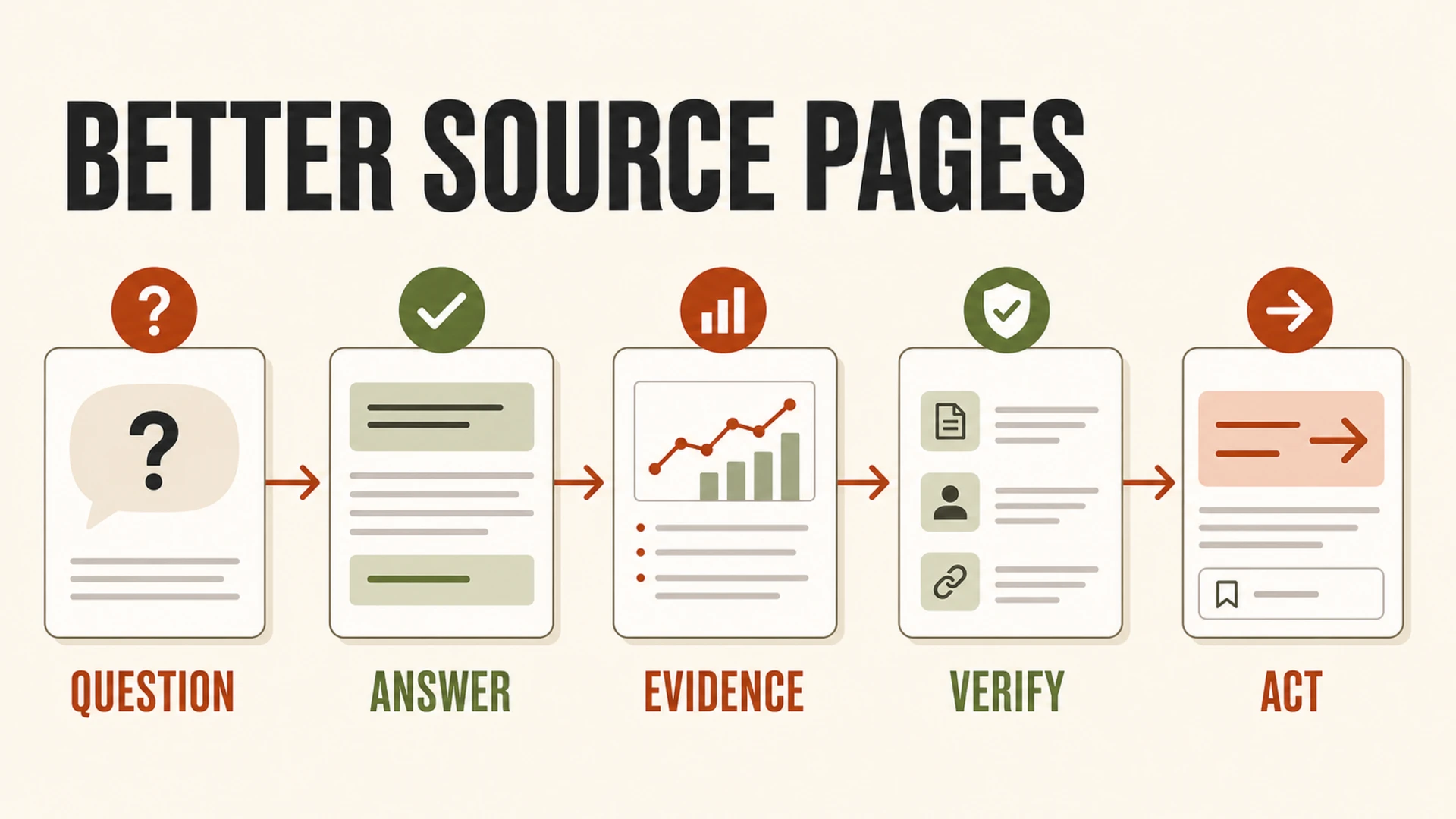
AI search can fan one question out into several related searches. It can compare options, assemble an explanation, and point a user toward supporting pages. It still needs useful pages to work from.
That is where many business websites come up short. A service page may name an offer but never explain who it is for, what the work includes, which evidence supports the claims, or what should happen next. Adding an FAQ widget or an AI-search slogan does not repair that missing decision support.
This readiness standard is useful for the problem. It does not mean building a site for robots instead of people. It means making important information clear, crawlable, internally connected, and verifiable enough that a buyer can act on it and a search system can understand what the page actually supports.
The decision task for this guide is specific: decide which page sections answer buyer questions well enough to be useful as supporting material, and identify the first gap worth fixing.
Start With The Buyer Decision, Not The Keyword List
Choose one page that should help create a qualified inquiry. Write down the decision a visitor is trying to make after landing there.
Examples include:
- Can this company solve my specific problem in my location?
- Does this service include implementation, or only recommendations?
- What information and access will I need before work starts?
- Is a focused sprint enough, or does the site need ongoing improvement?
- What evidence will show that the work was completed correctly?
This decision statement is more useful than a broad topic such as "AI search optimization." It gives every section on the page a job.
Next, write the likely follow-up questions. Google's current guidance explains that AI Overviews and AI Mode may use query fan-out, issuing multiple related searches across subtopics and sources. The practical lesson is not to manufacture a page for every wording. It is to make the main page complete enough to address the natural branches of the decision.
For a website growth service, the first question may be "Can you improve the site after the audit?" The follow-up questions could be:
- Which fixes are included?
- Who edits the site?
- How are changes reviewed before launch?
- How are forms, tracking, schema, and search access verified?
- What requires client approval?
- What happens after the initial fixes ship?
A weak page repeats the offer using different phrases. A stronger page assigns each follow-up question to a visible section, example, checklist, FAQ answer, or supporting page.
Use this first test:
- Pass: the page resolves one defined decision and answers the important branches.
- Gap: the decision is clear, but one or more follow-up questions have no useful answer.
- Conflict: two pages appear to own the same decision without a clear difference.
- Unknown: the team cannot agree on what the visitor should decide.
Do not write more copy until the decision is clear. If the page has no defined job, extra sections will usually add length without adding value.
Build A Six-Part Page Evidence Stack
A source-worthy page needs more than a fluent summary. It needs visible material that supports what the business wants a reader to understand.
Review the page in six parts.
1. Definition: Name the service, problem, or process in plain language. Explain what it includes and what it does not include.
2. Fit: State the customer, situation, location, platform, or constraint that makes the offer relevant.
3. Process: Show the main steps, inputs, owners, review gates, and expected deliverables.
4. Evidence: Support important claims with observable examples, screenshots, checklists, official sources, policies, credentials, or clearly labeled first-party experience.
5. Boundaries: State prerequisites, limitations, dependencies, approval needs, and cases where another path is better.
6. Action: Give the reader a next step that matches the decision, such as running a check, gathering access, reviewing scope, or requesting a focused implementation conversation.
Consider a page that says, "We make your website ready for AI search." That sentence is too broad to inspect.
A more useful version would explain that the work reviews crawl access, important service pages, query fan-out questions, internal links, visible proof, structured data alignment, and conversion paths. It would show a sample page-evidence checklist, identify what the client must verify, and link to a clear scope. The claim becomes a process a buyer can understand.
Use an evidence label for each major section:
- Verified fact: a current business fact that the owner or accountable team has confirmed.
- Official guidance: a requirement or recommendation linked to the original publisher.
- First-party process: a real method the business uses and can explain.
- Representative example: a clearly labeled example that does not pretend to be a client result.
- Inference: a conclusion drawn from evidence, labeled with its limits.
- Unsupported claim: a statement that currently lacks a proof path and should be removed or rewritten.
This labeling can stay in the editorial worksheet rather than appear on the final page. Its purpose is to stop vague authority phrases from surviving review.
Google's people-first content guidance asks whether a page provides original information or analysis, adds value beyond sourced material, demonstrates experience, and helps a reader achieve a goal. The evidence stack turns those questions into a page-level edit.
Run The Answer To Evidence Trace
Pick the five questions most likely to influence the buyer's decision. For each question, trace a short path through the page.
Record:
- Question: the exact issue the buyer needs resolved.
- Direct answer: the first sentence that answers it without a long preamble.
- Evidence: the visible fact, example, checklist, process detail, or official source that supports the answer.
- Boundary: the limitation or condition that prevents the answer from becoming misleading.
- Next link: the internal page that provides deeper context or the relevant action.
Here is a representative example for an implementation service.
Question: Does the engagement include fixing problems or only identifying them?
Direct answer: The scope includes implementing the approved fixes listed in the sprint brief, followed by production verification.
Evidence: The page names the included deliverables, approval gate, QA checks, and closeout evidence.
Boundary: Platform migrations, new paid tools, and work outside the approved URLs require separate scope and approval.
Next link: The one-week sprint at /sprint explains the focused implementation path, while /services/growth explains ongoing website improvement.
Now compare that with a weak trace.
Question: How will the work be verified?
Direct answer: "We use industry-leading best practices."
Evidence: none.
Boundary: none.
Next link: a generic contact button.
The weak version is not improved by adding synonyms. It needs named checks, a visible pass condition, and a scope boundary.
Mark the trace as failed when any of these conditions appears:
- The answer is hidden inside an image, video, tab, or script that is not reliably available as page text.
- The answer depends on a statistic, testimonial, certification, location, price, or service detail that cannot be verified.
- The heading promises an answer but the section only restates the question.
- The supporting source is a secondary summary when an official source is readily available.
- The FAQ claims something the body never explains.
- The structured data contains a fact, offer, review, or answer the visitor cannot see.
- The next link leads to a page with a different or contradictory offer.
This trace is the original work that makes a page more useful. It is also a better editorial deliverable than a vague instruction to "optimize for citations."
Check The Technical Foundation Without Inventing AI Requirements
Google says there are no additional technical requirements or special schema needed to appear as a supporting link in AI Overviews or AI Mode. The page must be indexed and eligible to appear in Search with a snippet. Its guidance continues to emphasize crawl access, internal links, page experience, important content in textual form, quality supporting media, and structured data that matches visible text.
Run this technical check on the exact public URL:
- The page returns a successful response without a login, accidental noindex directive, or blocked crawl path.
- The canonical URL identifies the intended version of the page.
- The title and main heading accurately summarize the decision the page supports.
- Important answers and facts exist as readable HTML text.
- At least one relevant page links into this page using understandable context.
- The page links to the next supporting service, resource, or action.
- Images have useful alt text, but no important answer exists only in the image.
- Article, organization, service, breadcrumb, or FAQ structured data is used only where appropriate and matches visible content.
- The live page is tested after publishing, not only in a local preview.
Google's structured data policies say markup should describe visible, relevant content and should not be misleading. Passing a syntax test does not guarantee a rich result, indexing, ranking, inclusion, or citation.
The same caution applies to the phrase "agent-ready." There is no universal agent-ready certification for a business website. Do not add an AI text file, special schema type, hidden answer block, or mass-produced page because a vendor claims it is mandatory. Ask for the official requirement, the supported system, and the observable effect.
Technical access is necessary, but it is not the whole decision. A perfectly crawlable page can still be vague, duplicated, unsupported, or impossible for a buyer to act on.
Choose The First Page Fix With A Failure Ladder
Turn the review into a short implementation queue. Fix the earliest failure on the most valuable buyer path.
Use this order:
1. Access failure: the intended page cannot be crawled, indexed, or loaded reliably.
2. Ownership failure: no page clearly owns the buyer decision, or several pages compete with near-duplicate answers.
3. Answer failure: the page does not directly resolve the main question or its important branches.
4. Evidence failure: a claim lacks visible, current, and checkable support.
5. Consistency failure: headings, body copy, images, schema, and linked pages disagree.
6. Action failure: the reader cannot take a relevant next step or the contact path is broken.
7. Measurement failure: the page works, but the team cannot observe discovery, engagement, assisted inquiry, or lead context.
Write each fix as a verifiable outcome.
Weak task: Improve the page for AI search.
Verifiable task: Add a visible implementation section that names the five included QA checks, links to the sprint scope, and states which changes need client approval. Confirm the section is readable on mobile, included in the live HTML, internally linked, and reflected accurately in Article or FAQ data where applicable.
Another example:
Observed: The service page says "full-service growth" but does not explain whether Ashfield implements technical fixes.
First fix: Add a plain-language scope section that separates diagnosis, implementation, verification, and ongoing work.
Evidence required: Final live URL, screenshot or rendered review, linked scope page, and a successful crawl or inspection check.
Close condition: A new reader can answer who does the work, what ships, what requires approval, and which next step applies.
This method keeps the content project tied to a buyer outcome. It also gives developers, writers, and owners the same definition of done.
Measure Discovery And Use Without Promising Citations
No page checklist guarantees that an AI system will cite, summarize, rank, crawl, or index a page. Measure observable stages instead.
Start with access and discovery:
- Is the intended URL indexable and present in the search index?
- Are internal links leading crawlers and people to it?
- Are the correct title, snippet controls, canonical, and structured data visible on the live page?
- Are search impressions appearing for the main decision and relevant follow-up questions?
Then review use:
- Do visitors move from the guide to the relevant service, audit, sprint, resource, or contact page?
- Do inquiries preserve the landing page and enough context to understand what helped?
- Do sales or support conversations reuse the checklist or ask the questions the page was designed to answer?
- Are people leaving because the content is irrelevant, or because the answer helped them complete the task without another click?
Bing announced an AI Performance view in Webmaster Tools that can show when publisher content appears in Microsoft Copilot, AI-generated Bing summaries, and some partner integrations. Where that current access exists, use it as observed platform evidence. Do not generalize it into a universal citation score.
Keep a small page decision log:
- URL and decision task.
- Questions the page is meant to answer.
- Evidence blocks added or corrected.
- Technical and internal-link changes.
- Publish and verification date.
- Search, AI-reference, and inquiry observations.
- Next review date and owner.
This log makes later updates more disciplined. The team can see whether a page needs a current fact, a clearer answer, a better link, a technical repair, or no change at all.
Frequently Asked Questions And The Ashfield Path
What makes a website ready for AI-assisted search?
It is a website whose important pages give people and AI-assisted search systems clear, crawlable, verifiable information for a real decision. It is a page-quality standard, not a special protocol or certification.
Does Google require special schema for AI Overviews or AI Mode?
No. Google says there are no extra technical requirements or special schema for these features. Normal Search eligibility and SEO foundations still apply, and structured data should match visible page content.
How can I tell whether a page is strong enough to support a citation?
You cannot guarantee a citation. You can verify that the page owns a distinct decision, answers the likely follow-up questions, uses checkable evidence and original process detail, states its boundaries, is technically accessible, and connects to a useful next action.
Should I publish a new AI-search page or improve a service page?
Improve the existing service page when it already owns the decision but lacks clarity or proof. Create a new resource when the question has distinct intent, needs substantial explanation, and would be useful to the audience even without AI-search traffic.
What should a small business fix first?
Fix the earliest failure on the highest-value buyer path. Start with access, then page ownership, answers, evidence, consistency, action, and measurement. Verify the live outcome before expanding the program.
If one important page has a contained answer, evidence, schema, internal-link, or contact-path problem, the focused implementation route is /sprint.
If the problem repeats across service pages, technical SEO, content, tracking, and ongoing improvements, review Ashfield's Growth Engine + GEO work at /services/growth. In this context, GEO means making the same pages genuinely useful, clear, crawlable, and source-worthy. It is not a separate bag of tricks.
Use /audit when the first priority is unclear, or /contact to send Ashfield the page and buyer decision you want reviewed.
The useful outcome is not an "AI-ready" badge. It is a better page with a defined job, direct answers, visible evidence, honest boundaries, working technical access, and a next step a real buyer can use.
Sources Used For This Page Evidence Check
- Google Search Central: AI features and your website: https://developers.google.com/search/docs/appearance/ai-features
- Google Search Central: Creating helpful, reliable, people-first content: https://developers.google.com/search/docs/fundamentals/creating-helpful-content
- Google Search Central: General structured data guidelines: https://developers.google.com/search/docs/appearance/structured-data/sd-policies
- Bing Webmaster Blog: Introducing AI Performance in Bing Webmaster Tools Public Preview: https://blogs.bing.com/webmaster/February-2026/Introducing-AI-Performance-in-Bing-Webmaster-Tools-Public-Preview
FAQ
What is an agent-ready website?
It gives people and AI-assisted search systems clear, crawlable, and verifiable information for a specific decision. Important pages define the service or topic, answer likely follow-up questions, show visible proof and limitations, connect to supporting pages, and offer a useful next action. It is a practical page-quality standard, not a special technical protocol.
Does Google require special optimization or schema for AI Overviews and AI Mode?
No. Google says the same foundational SEO practices remain relevant and there are no additional technical requirements or special schema needed for its AI features. A supporting page must be indexed and eligible to appear in Search with a snippet. Structured data should describe content that is visible on the page.
How do I know whether a page is strong enough to support an AI citation?
No checklist can guarantee a citation. Review whether the page answers a distinct buyer task, covers related questions, uses specific and checkable facts, provides original examples or process evidence, is crawlable and internally linked, and makes its scope clear. Then use search and analytics evidence to observe discovery and assisted actions without inventing attribution.
Should I create new AI-search pages or improve existing service pages?
Improve an existing page when it already owns the buyer decision but lacks useful answers, proof, or technical access. Create a new page only when the question has a distinct intent, needs substantial explanation, and would remain useful to your audience even without AI-search traffic. Avoid near-duplicate pages built only to capture query variations.
What should a small business fix first for AI-search readiness?
Fix the earliest failure on the highest-value buyer path. Restore crawl and index access first, then clarify the service and decision, add missing evidence, connect the page through internal links, align schema with visible facts, and repair the contact path. Verify each change on the live page before expanding the content program.
Keep reading
What Fail-Closed QA Means Before a Local Post Goes Live
AI and content calendars make it cheap to ship local posts. Fail-closed QA is the opposite habit: named checks that block publish when the copy would misrepresent a shop, pad a suburb, skip the call path, or invent a fact.
What Actually Moves Calls for Multi-Location Home Services (Maps, Pages, Conversion)
If call volume is flat, more blog posts are usually the wrong first move. Inspect the Maps listing a buyer actually sees, the location or service page they land on, and the tap-to-call or form path that has to finish the job.
How Multi-Location Home Service Brands Keep City Pages Distinct
A city-page farm can look like coverage while giving buyers the same thin answer in ten URLs. Use this method to approve only the markets that differ, publish what must be distinct, and keep those pages current on a weekly cadence.